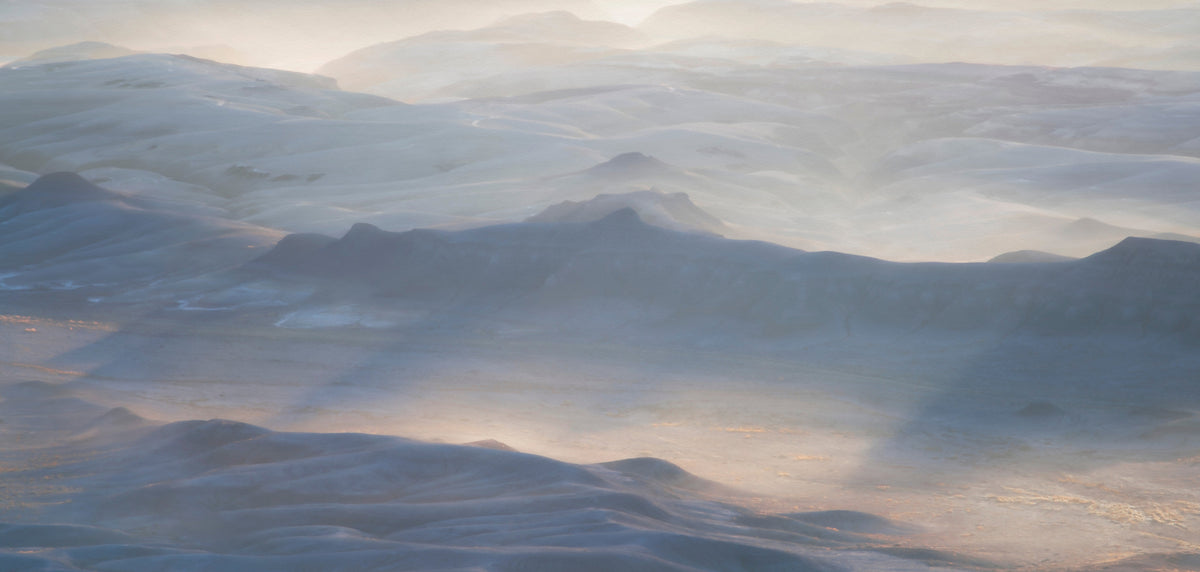
For nearly three decades, photography has allowed TJ Thorne to look more closely at the world around him. Drawn to abstraction, overlooked details, and the shifting relationship between light and landscape, he uses the camera to pay attention. When photographing moving water, dense forests, desert light, or the subtle textures of an ordinary scene, his work starts with presence. The photographs themselves, he says, are more like “postcards from the experience,” traces of an encounter influenced as much by his inner state as by the landscape in front of him.
In this conversation, we talk about abstraction, impermanence, life on the road, slowing down, and what happens when an intimate photographic moment expands to the scale of a wall.

Your work often feels like painting more than photography. What draws you toward abstraction?
Abstraction allows me to photograph through my inner state rather than just record what's in front of me. I'm not limited to reality's textures and tones as given; there’s much more latitude to use the visual elements. I can use the aspects of a scene that I want to communicate or evoke a feeling. Instead of "here's a picture of a thing," it says, "here's a picture about a thing.”
It also creates a deep intimacy with the moment. Since I'm usually zoomed in and working with smaller scenes, I get to interact with different aspects of what I'm photographing. Combined with the experimentation, it results in a flow state where everything melts away, and I'm just left in existence with the moment, communing with the scene in a way that only I can. And after nearly three decades of photographing, straightforward representations of the world, while meaningful, don't give me the creative invigoration I need to feel fulfilled. Abstraction leaves room for experimentation that keeps the photography side of it fun.
For the viewer, I enjoy the mystery it provides. It removes preconceived attachments to literal subjects or locations and invites an emotional reaction to the colors, textures, and shapes instead. It opens the image up rather than closing it down.

What are you hoping someone feels before they identify what they're looking at?
I hope that they experience the wonder, gratitude, and serenity that I photograph through. But more than that, I hope they experience curiosity. One of the best compliments that I’ve received numerous times about my work, specifically my water work, is that after seeing my work, they started to look at water differently. So it’s not even about my work exactly, but the fact that I gave them a window into enriching their own lives. Water is so constant in most people’s lives that habituation makes it invisible, taken for granted. Familiarity does that. I am grateful that my work interrupts that for people and gives them a reason to look at it again.
Since I mostly shoot smaller scenes and abstractions, I don’t have to go somewhere pretty to get pretty photos. I just look deeper into my surroundings and interact with the overlooked beauty. It’s everywhere. Sometimes people just need a reminder to stop and see.

How do you know when an image is finished?
Usually when I feel that all of the colors, tones, textures, and details are in harmony, highlighting what I want to highlight or communicating what I want to communicate. I used to be a huge perfectionist, but more and more I am allowing a bit of wabi sabi into my work. I used to think that the perfectionism was mirroring how perfect the experience was to me, but now I feel that it sterilizes the work a bit. Besides, there’s no such thing as perfection. So instead of chasing a version of the image that doesn’t exist, I am allowing the imperfections to exist alongside my own, and I feel much more free as a result.

Is there a tension you're always chasing in your work?
I’m not so sure I’m chasing a tension, as that implies a pursuit and a desire for the tension to either resolve or capture it. My work is primarily about harmony, which is in opposition to tension. But there are certainly tensions that I deal with that I have learned to stop running from and work within. The tension between presence and impermanence: For instance, with photographing moving water. I’m drawn to it precisely because it never holds still. Every click of the shutter is a negotiation between being fully in the moment and also knowing that the moment has already passed. My work is often made in conditions that reward stillness, patience, and slow seeing, but my subjects are frequently in motion.
And the tension of having the desire to communicate something about my inner state using subjects that are entirely exterior and provided to me. The gap between what the world offers and what I make of it with my camera is the area of tension that I’ve learned to work within.

What role does chance play in your photography?
None at all. One of the things I love the most about the way that I photograph is that I’m adaptable and can work with what is given to me, no matter the conditions. From dense fog, to the barren days of winter, to direct mid-day light, I meet the landscape where it is. Certainly there are those magical moments that are a result of the intersection of time and place, and I value those as well, knowing that every single decision in my life led me to that moment, to notice that thing, and feel like it was made just for me.
But I have that gratitude for the less obviously magical moments as well. The ordinary puddle in a grocery store parking lot, a pile of trash bags under streetlight in New York City, decomposing leaves on the forest floor. They’re all magical in their own ways and are found where my experience meets genuine presence and openness.