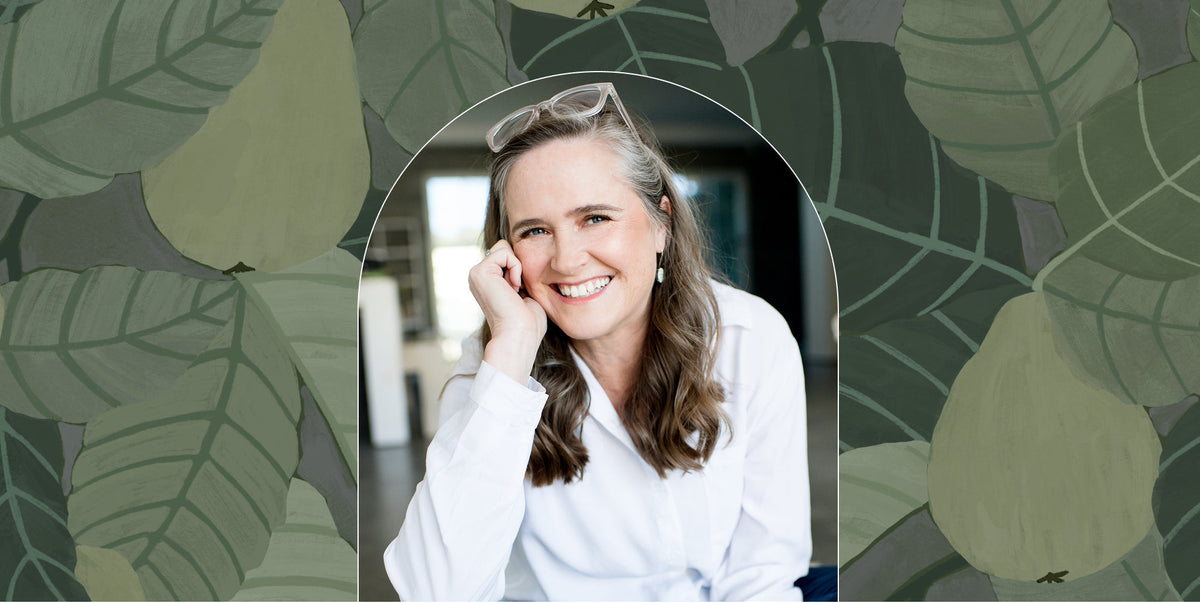
For artist and surface pattern designer Katie O’Shea, creativity begins with curiosity: a new set of paints, a morning spent in a sketchbook, a plant sprouting up in the backyard. Raised in an artistic family and trained in graphic design, Katie eventually found her way to surface pattern design, where illustration, color, texture, and pattern could all come together. Her collaboration with Artscape brings that approach to the wall through two expressive botanical designs, including Anjou, inspired not by pears, as you might expect, but by a prolific quince plant growing in her own yard.
We caught up with Katie to talk about sketchbook rituals, Art Nouveau, the importance of working by hand, and why sometimes the best place to make art is on the living room couch.

Can you tell us a little about your background and how you came to do what you do?
I had an artistic family. My mom is a painter and my dad is a printmaker, although he wasn’t when I was growing up. He was a businessman. So I think art just felt like a natural path for me based on my family’s history. I went to art school and studied graphic design, and then I just wanted to have fun for a while. I traveled on a boat and worked in San Francisco before eventually getting back into multimedia. Then we had kids, and it took about 20 years for me to come back to doing art again.
Once I felt ready to start making art again, I got into surface pattern design. It worked well with my graphic design background because I was using many of the same programs and tools, but to me it felt so much freer and more fun. I could integrate illustration and color and all the things that felt a little more subdued in graphic design.
What does your creative practice look like day to day? Do you have a studio?
I do have a studio in the house, but there are two parakeets in there and they’re extremely loud! I have to put in earbuds or earplugs if I’m going to work in there, so I end up working a lot at the coffee table in the living room. I feel more comfortable there because I can talk to my family while I’m working. I also find that the pressure I put on myself to produce something good is a lot less when I’m sitting in the living room rather than at my studio table, where everything is quiet, except for the birds. It’s funny that I have this beautiful room to work in, but a lot of the time I’m on the couch.
Where does your process usually begin?
I have about five different sketchbooks right now, so it depends on what materials I want to work with that particular day. Right now I’m doing ink line drawings, but last week it was watercolors. I like to move between different mediums and whatever is inspiring me. It’s not very well planned. It’s intuitive. I try to sit down first thing in the morning because that always feels best. I feel the most fresh and ready to see the art I did the day before differently. I like starting the day with a sketchbook practice, and I don’t really feel quite right if I don’t get that time in. As the day progresses, there are so many other things to do and take care of. At least if I sit down first thing in the morning, I usually get something going in my mind that I can keep thinking about throughout the day.

Can you tell us about the designs you created for Artscape and where they began?
The one that looks like pears, Anjou, started as a sketch in my notebook using gouache paints. They look like pears, but it was actually a quince plant that we had in our yard. It produces a ton of fruit, and I’ve taken a lot of pictures of the tree. I really like the shape of the leaves and the shape of the quince, which happen to look like pears. We don’t really eat them, but our friend takes them and makes quince jam.

The other design, Buttercup, came more from my imagination. It isn’t based on any particular plants or reference images. I really like trying to push my imagination rather than always using a reference photo to draw from. That particular design has had a lot of different iterations since then, so it seems to be a style I keep coming back to and enjoying. The quince design started with gouache, and the other was a fine-line ink drawing. They both began as sketches. I usually capture the original with my iPad and then recreate it digitally so I can turn it into a repeating pattern.

What inspires you outside of the sketchbook?
Actual materials inspire me. Having a new set of paints or a new pen really gets me started. I also have a ridiculous number of photos on my phone. I can search for something like “hydrangea” and all these photos come up, so I’ve created a good library of reference material. And I know it’s all stuff I’ve photographed myself. Of course, other artists inspire me too. Looking at other artists’ work and seeing what people are doing and how they interpret whatever is around them is always inspiring. I tend to stick to one motif rather than mixing things up, and that’s something I want to work on: integrating birds with plants, flowers, and different things rather than always focusing on the one plant I happen to be interested in.
How do color and texture show up in your work?
I like blues and greens more than red, but then I end up drawing more with red, which is really interesting. As far as texture, I think it really helps a piece to have a lot of texture rather than looking flat. When I started doing surface pattern design, I focused on learning how to put patterns together. Once I had that idea down, I went back and focused more on fine art, drawing, and painting and began incorporating that into making repeat patterns. Texture makes a piece feel so much more unique and special, especially when you can bring painterly texture into it. I work plenty digitally, but I try to recreate that texture digitally too when a digital file is required.

Are there particular artistic eras or traditions you return to for inspiration?
Art Nouveau was a big inspiration for me at first. Some people say they see it in my work all the time, although I don’t actually see it coming out in my work. I have a big encyclopedia of patterns on my table that I look through for inspiration, and Art Nouveau is always one that makes me go, “Ah,” when I see it. Of course, William Morris and that whole movement are pretty incredible, especially when you think about what they could do without all the technology we have now.
I also get inspiration from current artists, usually fine artists more than surface pattern designers, and often their work is totally different from mine. I get distracted by lots of different styles and think, “Oh, would I be able to do that?” It’s interesting how your mind travels around and then comes back to the same things you always want to draw. I love all the patterns. It’s a great thing to find something that you love seeing every day, in everyday life.

What kinds of spaces do you imagine your Artscape designs living in?
Hopefully somewhere unique where somebody really wants to highlight the art. I don’t see them as designs that fade into the background as much as something you might use on an accent wall. The colors are fairly soothing, so hopefully they create a nice, calm, relaxed space. Maybe an entryway for the pears. The flowers could be beautiful in a bedroom, maybe even a young person’s bedroom or a dorm room.

What do you hope someone feels when they walk into a room with your wallpaper?
I think it would be wonderful if somebody saw it and thought, “Wow, that’s a really unique way of seeing leaves and pears, or flowers and vines growing up.” Hopefully it creates a unique experience rather than feeling like a generic wall mural.

Working by hand seems to be an important part of your process. What does craft mean to you?
I would say that the digital part comes last. I spent the beginning of this year doing a 100-day project, making artwork every day for 100 days straight. I have all these pieces now, but the practice itself took me more deeply into the analog side of art rather than the digital side. I also have a stack of sketchbooks that I go through, and they bring back all these memories of what I was thinking and what inspired larger pieces, like the ones for Artscape. You just never know, as long as you keep that practice going, when something will strike and feel exciting enough that you want to take it further.
What advice would you give to artists and designers who are finding their own creative voice?
Just try to stay true to yourself and not worry about what trends are out there. If you’re trying to chase a trend, it’s not going to be true to you, and it might not come out the way you want it to. It’s pretty hard to sit down and try to do something and not have it come out the way you want. It just makes you want to give up. But if you do what’s exciting to you, it’s going to shine through.

Is there a detail about your studio that might surprise us?
Probably the two birds! They don’t stay in their cage. They can fly around the room, and I have different branches set up for them. They’re pretty free to roam. They could even fly into the house if they wanted to, but they tend to stick near their cage where their food is. I also have a shelf that I recently organized with all the fabric collections I’ve worked on together. It’s really nice to see all the different collections in little stacks. I feel very at home in that space, surrounded by patterns.
And finally, what has it been like collaborating with Artscape?
It’s been great. Kate, Artscape’s art director, has been really easy to work with, and I’m looking forward to seeing the other artists Artscape launches and the collaborations you’re doing.
Explore Katie's Wallpaper Collection
Follow Katie on Instagram